Same line stake: useful for seeing the added singles
Take four illustrative decimal prices: A=2.00, B=3.00, C=4.00 and D=5.00. With £1 per line and all four won, the Yankee returns £345 from £11 staked. Lucky 15 returns £359 from £15 staked. The extra £14 consists of the four single returns. The extra cash cost is £4, so the difference in net profit is £10.
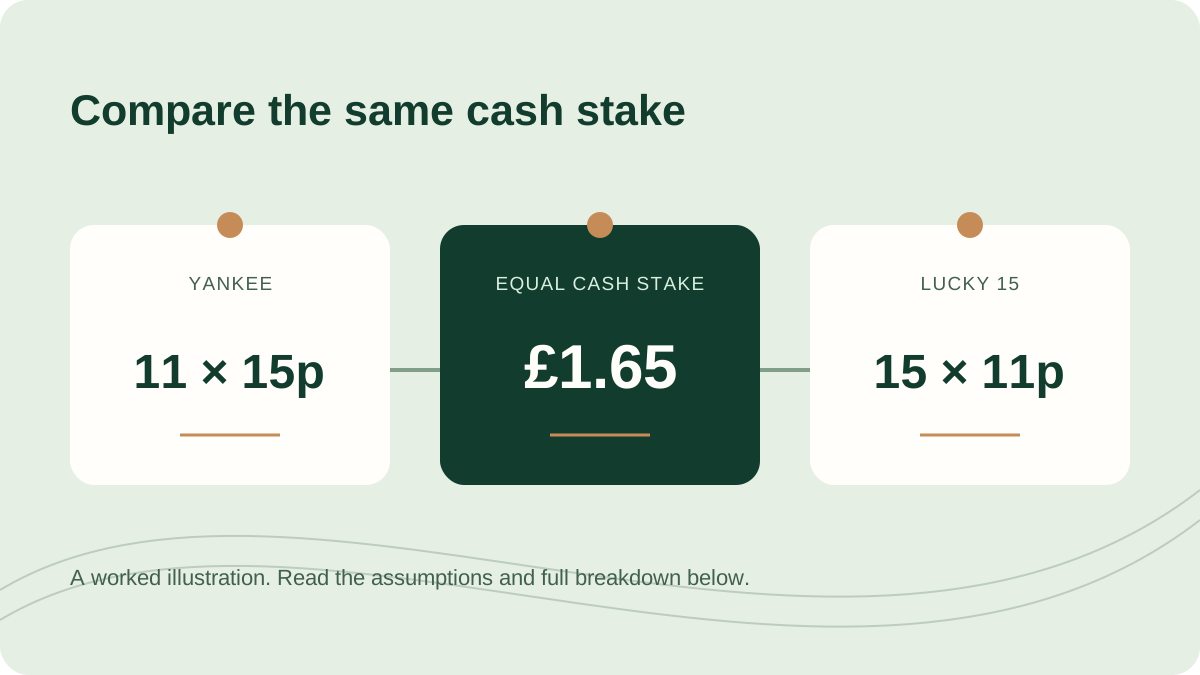
Same total stake: £1.65 on either system
To hold the total budget constant without splitting pennies, use 15p on each of 11 Yankee components or 11p on each of 15 Lucky 15 components. Each costs exactly £1.65. These small hypothetical amounts are chosen to make the comparison exact, not to suggest a stake.
| Result | Yankee, 15p per line | Lucky 15, 11p per line |
|---|---|---|
| All four win | £51.75 | £39.49 |
| A, B and C win | £7.50 | £6.49 |
| Only A and B win | £0.90 | £1.21 |
| Only D wins | £0.00 | £0.55 |
| All lose | £0.00 | £0.00 |
Subtract the same £1.65 from both columns
With only A and B won, the Yankee loses 75p overall and the Lucky 15 loses 44p overall. With only D won, the 55p single return still leaves a £1.10 loss. A non-zero return is not proof of a positive result.
These scenarios do not establish which is better
The table conditions on stated outcomes. It assigns no probability to them and makes no forecast. Different prices, outcomes, rounding conventions and concessions change the figures. Comparing expected value would require a justified probability model; prices alone do not supply that model.
Use the full breakdown when something differs
Check the eleven Yankee components and fifteen Lucky 15 components. Then reproduce the relevant receipt in the system calculator. Keep operator bonuses and each-way conditions outside this ordinary win-only comparison.
Source and calculation scope
Sky Bet: bet types is the reference for the named system structures. Reviewed . Component returns and scenarios here are our own calculations, not an operator quotation. See methodology and rounding.