Four singles plus the eleven Yankee lines
The name describes fifteen component bets, not a £15 minimum or a guaranteed return. A 10p-per-line Lucky 15 costs £1.50; a £1-per-line version costs £15. This page models cash win bets. An each-way version needs a separate win/place model and is not represented by the figures below.
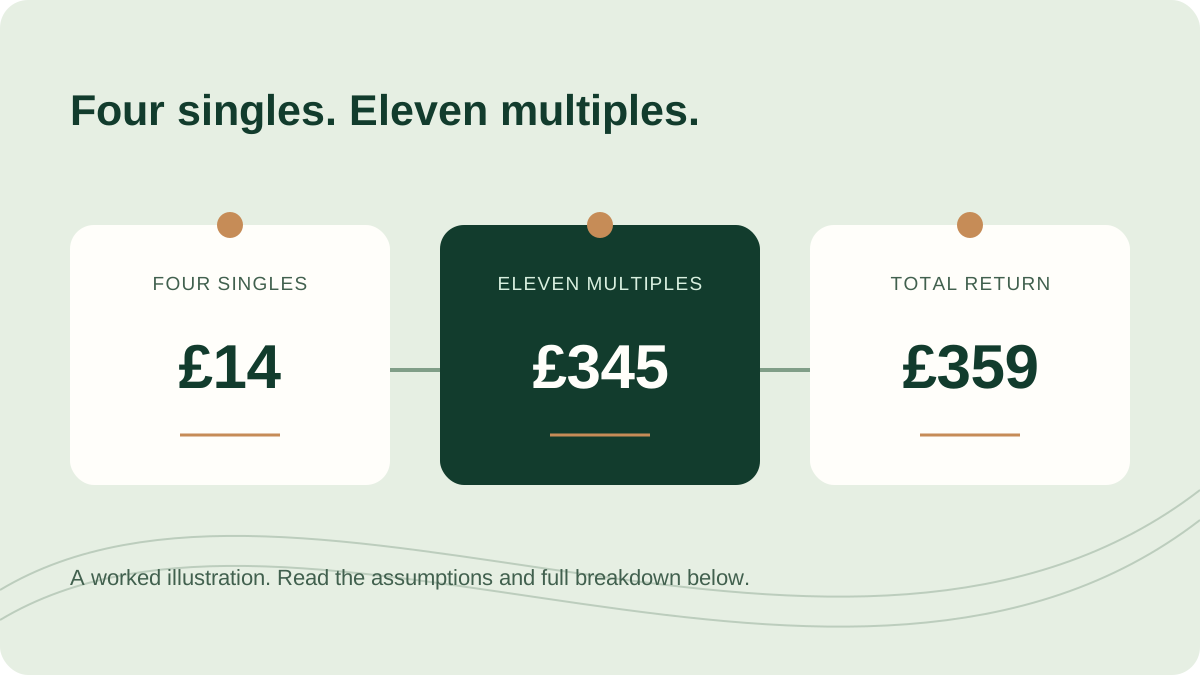
Our example uses decimal prices 2.00, 3.00, 4.00 and 5.00 with £1 on every line. With all four selections won, the four singles return £14, the six doubles £71, the four trebles £154 and the fourfold £120. The total return is £359 and the net profit is £344.
Every component bet.
15 separate lines.
£1.00 staked on each.
| Selections | Component | Status | Return |
|---|---|---|---|
| A | Single | Returned | £2.00 |
| B | Single | Returned | £3.00 |
| C | Single | Returned | £4.00 |
| D | Single | Returned | £5.00 |
| A + B | Double | Returned | £6.00 |
| A + C | Double | Returned | £8.00 |
| A + D | Double | Returned | £10.00 |
| B + C | Double | Returned | £12.00 |
| B + D | Double | Returned | £15.00 |
| C + D | Double | Returned | £20.00 |
| A + B + C | Treble | Returned | £24.00 |
| A + B + D | Treble | Returned | £30.00 |
| A + C + D | Treble | Returned | £40.00 |
| B + C + D | Treble | Returned | £60.00 |
| A + B + C + D | 4-fold | Returned | £120.00 |
One winner returns a single, not the whole stake
If only selection D at 5.00 wins, its £1 single returns £5. Every other component contains a losing selection. The result is £5 returned against £15 staked, a £10 net loss. “A return with one winner” should never be read as “a profit with one winner”.
Two winners: include both singles and their double
If only A at 2.00 and B at 3.00 win, the surviving lines return £2, £3 and £6. Total return is £11 and net result is −£4 after the full £15 outlay. If A, B and C win while D loses, the surviving singles and multiples return £59, producing £44 profit.
Bonus wording is a separate layer
Some receipts may refer to a one-winner concession or an all-winners bonus. Do not assume the product name establishes eligibility, the bonus percentage or how void selections affect it. This example and calculator include no such extra payment. Compare the ordinary component calculation first, then examine the specific concession terms separately.
Do not compare different budgets as if they were equal
At the same £1 line stake, a Lucky 15 costs £4 more than a Yankee. If your question is how two structures behave for the same total cash stake, use different per-line amounts that divide exactly. See the £1.65 equal-budget example for a reproducible comparison.
A receipt checklist
- Confirm the named system and cash win-only scope.
- Record whether the amount is per component or the whole stake.
- Copy accepted odds and the declared result of every selection.
- Compare each surviving line before comparing the total.
- Check any separate deduction, promotion or rounding convention.
Source and calculation scope
Sky Bet: bet types is the reference for the named system structures. Reviewed . Component returns and scenarios here are our own calculations, not an operator quotation. See methodology and rounding.