Why four selections produce eleven lines
With four selections, there are six distinct pairs, four groups of three and one group containing all four. A Yankee includes these eleven multiple bets and no singles. You pay the component stake eleven times. The £1 example below therefore starts with £11 cash at stake.
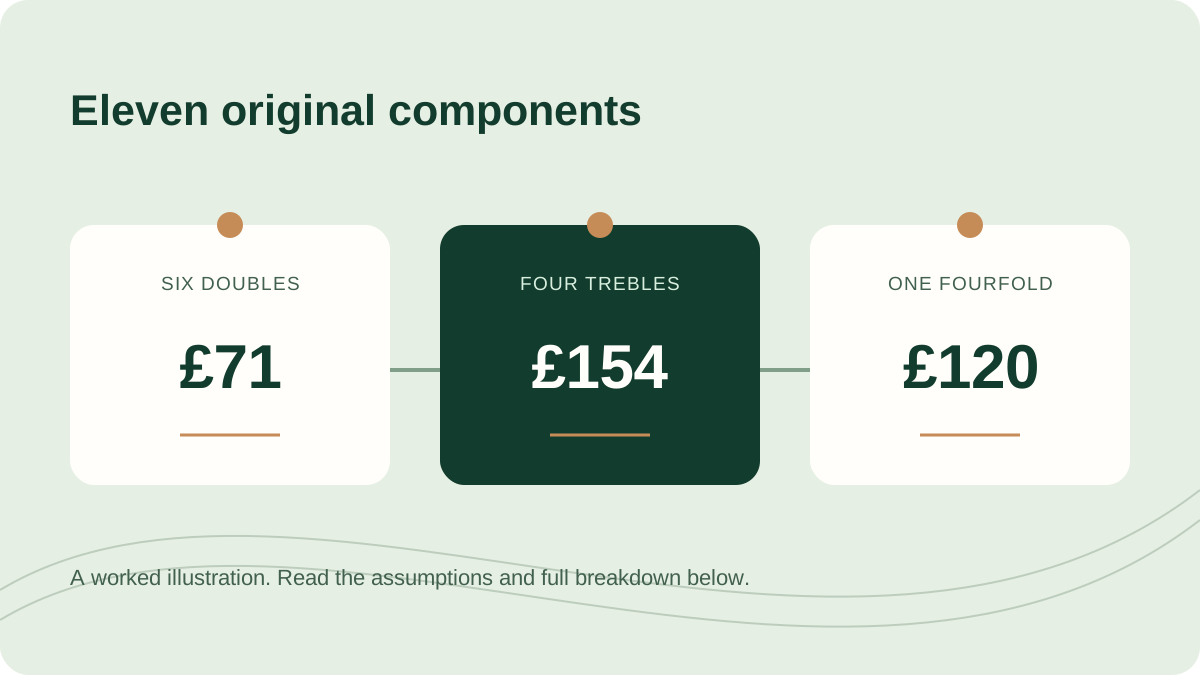
Use illustrative decimal prices A=2.00, B=3.00, C=4.00 and D=5.00. When all four win, the doubles return £71 in total, the trebles £154 and the fourfold £120. The full return is £345, including the returned component stakes.
Every component bet.
11 separate lines.
£1.00 staked on each.
| Selections | Component | Status | Return |
|---|---|---|---|
| A + B | Double | Returned | £6.00 |
| A + C | Double | Returned | £8.00 |
| A + D | Double | Returned | £10.00 |
| B + C | Double | Returned | £12.00 |
| B + D | Double | Returned | £15.00 |
| C + D | Double | Returned | £20.00 |
| A + B + C | Treble | Returned | £24.00 |
| A + B + D | Treble | Returned | £30.00 |
| A + C + D | Treble | Returned | £40.00 |
| B + C + D | Treble | Returned | £60.00 |
| A + B + C + D | 4-fold | Returned | £120.00 |
Three winners: the surviving Trixie structure
If D loses while A, B and C win, the surviving lines are A+B, A+C, B+C and A+B+C. They return £6, £8, £12 and £24, giving £50. The original stake remains £11, so profit is £39. You do not replace the original stake with the £4 cost of a newly placed Trixie.
Two winners can still leave a net loss
If only A and B win, the single surviving double returns £6. Against the original £11 outlay that is a £5 loss. A returned component is not the same thing as a profitable whole system. With just one winner, no ordinary Yankee component survives.
One void: count original components
If D is void and A/B/C win, all seven original components containing D are repriced: three doubles, three trebles and the fourfold. Set D to decimal 1.00 in each. The original doubles now return £35 in total, the trebles £50 and the fourfold £24: £109 returned against £11 staked. Components that now share the same remaining selections still carry distinct original stakes; replacing them with a fresh Trixie would discard those stakes.
Yankee versus Lucky 15
A Lucky 15 adds the four singles to the same eleven multiple components. At £1 per line it costs £15. With the all-winning example it returns £359, but comparing £359 with £345 alone ignores the different outlays. Our equal-budget comparison shows both views without recommending either structure.
A receipt checklist
- Confirm the named system and cash win-only scope.
- Record whether the amount is per component or the whole stake.
- Copy accepted odds and the declared result of every selection.
- Compare each surviving line before comparing the total.
- Check any separate deduction, promotion or rounding convention.
Source and calculation scope
Sky Bet: bet types is the reference for the named system structures. Reviewed . Component returns and scenarios here are our own calculations, not an operator quotation. See methodology and rounding.