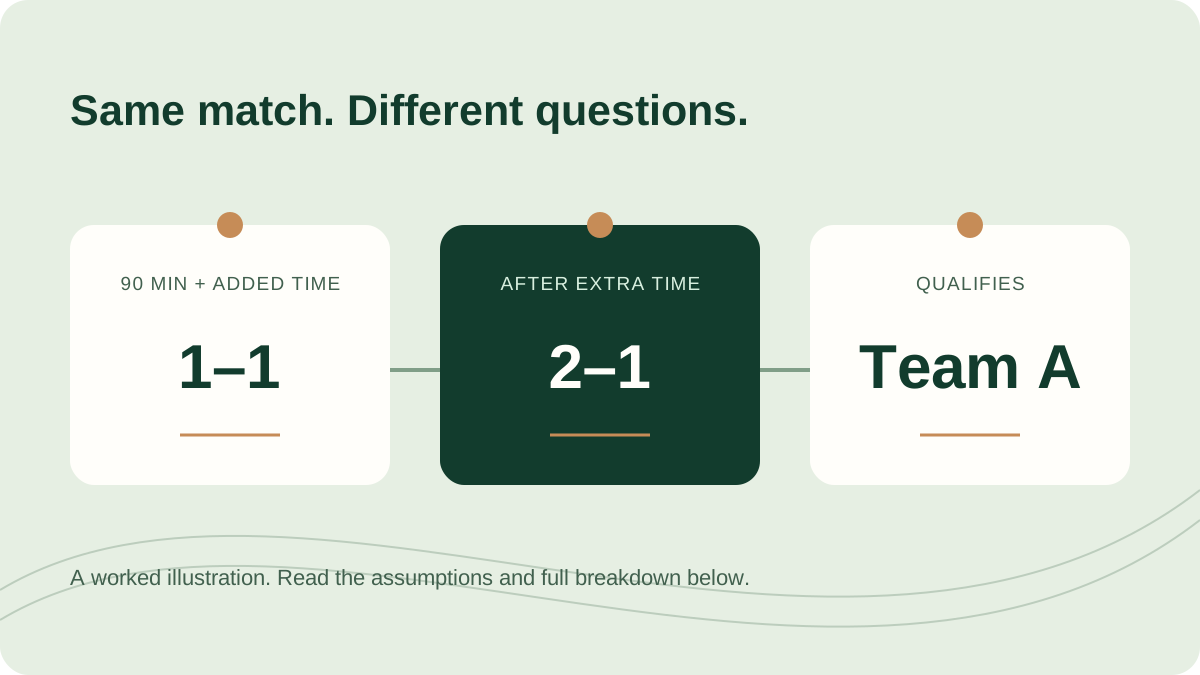
Three questions, three possible answers
| Market question | Read this condition |
|---|---|
| Result over the scheduled match period | Does it specify 90 minutes including stoppage time? |
| Result in extra time | Does the market cover extra time alone or include an earlier score? |
| Team to qualify | Which tie, leg or progression event is covered, and are penalties included? |
Stoppage time is not extra time
Added minutes compensate for stoppages within the scheduled period. Extra time is an additional period in competitions that use it. The phrase “after 90 minutes” often includes stoppage time under the relevant conditions, but does not automatically include extra time.
A score timeline you can test
Imagine a cup tie that is 1–1 at the end of 90 minutes plus stoppage time. Team A scores in extra time and goes through 2–1. In a hypothetical 90-minute result market with those stated terms, the outcome is a draw. A hypothetical “Team A to qualify” market asks a different question and would use the qualification outcome. Always check the actual contract: the example is not a settlement instruction for an unnamed operator.
Reference rule and exceptions
Sky Bet’s general football rules use 90 minutes, including stoppage time, unless a particular market states otherwise. They also describe shortened scheduled matches and unusual match formats. This is why checking the competition and advertised period matters even before considering extra time.
A short receipt checklist
- Copy the full market label, not just the selected team.
- Note whether the bet concerns one match, one half or a multi-leg tie.
- Record the score at the end of the relevant period.
- Check explicit extra-time and penalty provisions.
- Compare the outcome with that market before calculating a return.
An odds converter can explain the price; it cannot establish which period your bet covers. Resolve the market definition first.
Source and review
Sky Bet: general football rules. Reviewed . The reference describes that operator’s published scope. It does not establish the conditions of every bookmaker or the historical terms of your receipt.
Examples are original illustrations. See our methodology or report a correction.