Three selections create four separate bets
Label the selections A, B and C. The doubles are A+B, A+C and B+C. The treble uses all three. The same selection appears in more than one component, but each component has a separate stake. A £1 Trixie therefore has £4 at stake, not £1.
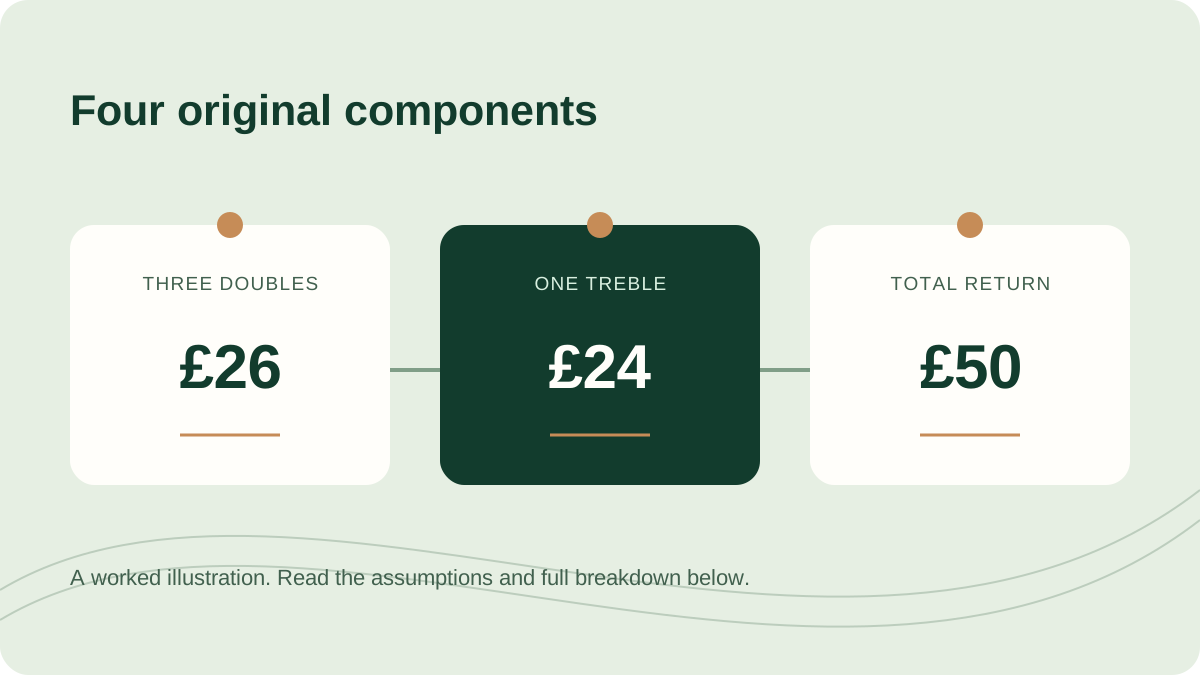
In this original example, A has decimal odds 2.00, B has 3.00 and C has 4.00. The prices are illustrative. All three selections win in the first table; no deduction or bonus applies.
Every component bet.
4 separate lines.
£1.00 staked on each.
| Selections | Component | Status | Return |
|---|---|---|---|
| A + B | Double | Returned | £6.00 |
| A + C | Double | Returned | £8.00 |
| B + C | Double | Returned | £12.00 |
| A + B + C | Treble | Returned | £24.00 |
Two winners: one double survives
If A and B win while C loses, A+B returns £6. The A+C and B+C doubles and the treble all lose. Total return is £6 and net profit is £2 after subtracting the full £4 stake. A statement such as “two winners pay” does not mean every pair of prices guarantees a net profit.
One winner: no ordinary return
One winning selection cannot complete any double or the treble. Every component loses, so the return is £0 and the net result is −£4. A special one-winner concession, if an operator offers one, requires separate conditions and is not built into the ordinary structure.
A void produces a different calculation
If A is void while B and C win, A+B becomes a £1 bet on B and returns £3. A+C returns £4. B+C returns £12, and the original A+B+C line also returns £12 after A becomes a multiplier of one. The £31 total includes both original £12 components; merging them would discard a real component stake.
Trixie versus Patent
A Patent adds A, B and C as three singles. At the same £1 component stake it costs £7 rather than £4. That changes the outlay and which outcomes return something. Compare complete cash stakes, not just the identical £1 printed beside each system name.
A receipt checklist
- Confirm the named system and cash win-only scope.
- Record whether the amount is per component or the whole stake.
- Copy accepted odds and the declared result of every selection.
- Compare each surviving line before comparing the total.
- Check any separate deduction, promotion or rounding convention.
Source and calculation scope
Sky Bet: bet types is the reference for the named system structures. Reviewed . Component returns and scenarios here are our own calculations, not an operator quotation. See methodology and rounding.