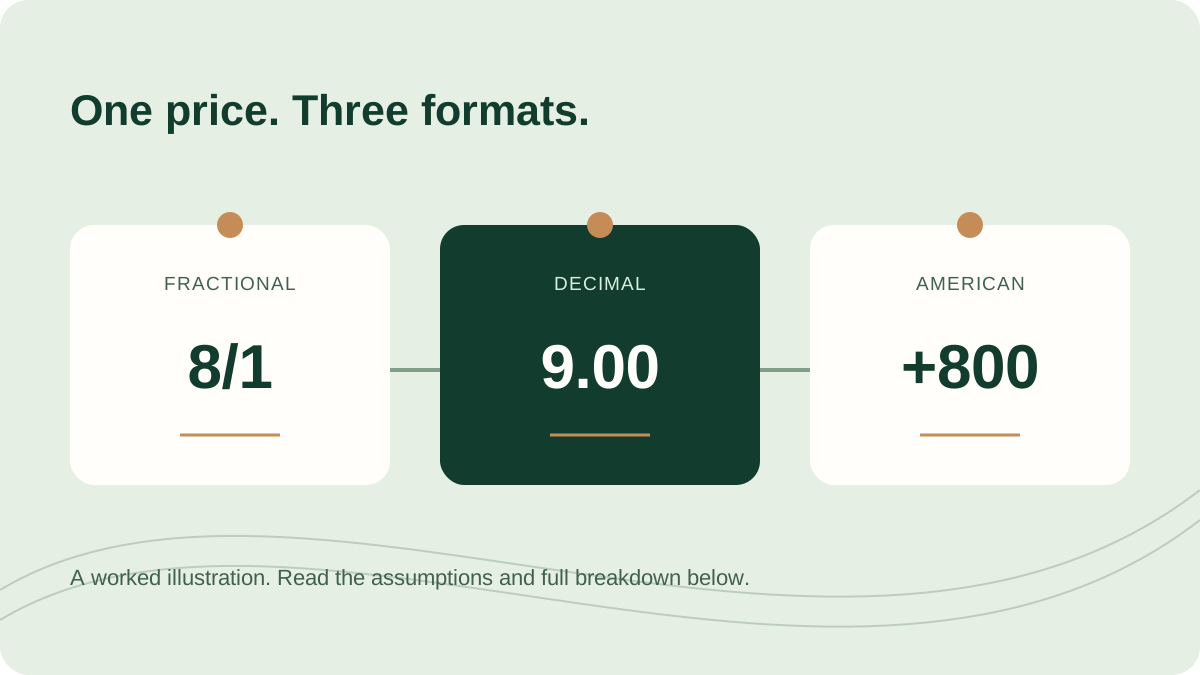
This page explains what the numbers mean. To convert a specific price, use the odds converter; the examples below use the same conversion.
Profit and total return
Fractional odds (such as 7/2) describe profit relative to the stake. Decimal odds (4.5) describe the total return per 1 unit staked, with the stake already included. American odds describe the same price from a different base: a positive figure (+350) is the profit on a 100-unit stake, and a negative figure (such as -200) is the stake needed to profit 100 units. Neither base is a recommended stake — it is only the scale the format uses.
Four prices, three formats
Scroll across the table to see all columns.
| Fractional | Decimal | American | Implied probability |
|---|---|---|---|
| 1/2 | 1.5 | -200 | 66.6667% |
| 1/1 | 2 | +100 | 50% |
| 7/2 | 4.5 | +350 | 22.2222% |
| 8/1 | 9 | +800 | 11.1111% |
1/2 is below evens: the price implies a probability above 50% (66.6667%), with a smaller profit than the stake. 1/1 is evens — profit equal to stake, implying exactly 50%. 7/2 and 8/1 are above evens, with profit larger than the stake and an implied probability below 50%. The decimal figure always equals the fractional profit plus 1; it is the stake returned once, together with the profit, not the two numbers added separately.
Implied probability is a calculation, not a forecast
Implied probability is 100 divided by the decimal price. At 8/1 (decimal 9), that is 11.1111%. This number comes only from the price; it does not measure an event's true chance, and it does not account for a bookmaker's margin across the whole market.
A hypothetical two-outcome market
To see that margin as arithmetic rather than as a claim about any real market: take a hypothetical two-way event where the two outcomes are mutually exclusive and exhaustive, so exactly one of them happens and a correct pair of probabilities would sum to exactly 100%. If both outcomes were each priced at decimal 1.90, each side's implied probability would be 52.6316%, and the two sides would sum to 105.2632% — above that 100%. That gap is only a property of these two hypothetical prices considered together. It is not a report of any operator's current prices, a measure of realised profit, or evidence of either outcome's true chance.
Decimal odds including the stake, with equivalent fractional and American prices for the same bet, is the general format convention referenced in Betfair's help pages on betting. We use that as a format reference only, not as confirmation of any current fees, margins or settlement terms.
Sources checked . These references describe the general mechanics referred to above; they do not establish the terms of any individual bet, and this page cites no current prices, fees or promotions. See our methodology for calculation assumptions, or use contact to report an error, including the page address and a non-personal example.